Go Back

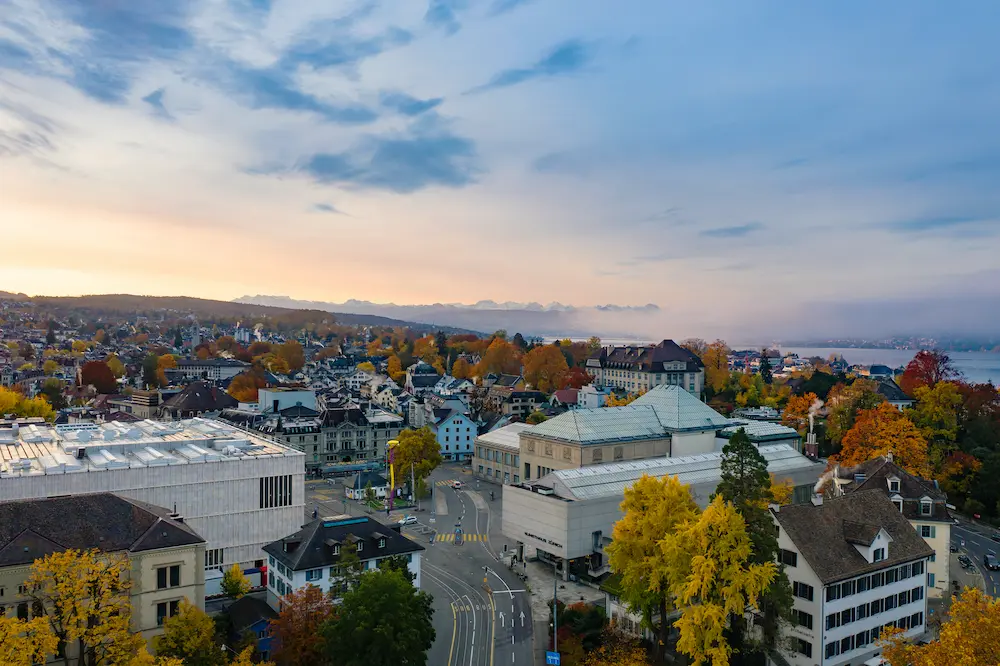
Zurich’s winter mists glide over the city in silvery haze, softening stone steeples and cobbled lanes into a scene of hushed elegance. Beneath frosted skies, the Kunsthaus Zürich gleams as a sanctuary of culture, its warmly lit galleries inviting the global aesthete in from the cold. Here at the Kunsthaus, the confluence of snow and art feels almost choreographed: pristine powder frames its façades, while golden light spills from the Chipperfield-designed foyer onto the new Garden of Art. It is a luxury pilgrimage for collectors and connoisseurs, a place where the silence of winter amplifies the poetry of each painting and sculpture.
The Kunsthaus’s David Chipperfield extension is a masterclass in restrained luxury. This pale-stone pavilion now makes Kunsthaus Zürich the largest art museum in Switzerland, comprising four buildings from different eras, uniting early-20th-century wings with contemporary minimalism. Its facade of vertical limestone fins combines tradition and innovation, echoing Zurich’s civic architecture in a modern key. Beyond its elegant skin, the extension opens up the Kunsthaus to the public. A vast glass foyer spans the building’s length, linking a new city square on one side with a serene Garden of Art on the other. By day and night this low-threshold entrance hall dissolves the barrier between city and museum. Here in winter sunlight, or the glow of festive lights, visitors walk from public plaza into art-filled space almost seamlessly. The effect is quietly grand: modern galleries meet the crisp air, and inside every hovering snowflake outside seems part of the exhibition’s cinematography.


At the Kunsthaus this season, Brazil’s modernist pioneer Lygia Clark offers a retrospective that is as much choreography as static display. Running November 2025 through March 2026, the show is the first comprehensive presentation of the Brazilian artist’s work in a German-speaking country, featuring over 120 historical works and dozens of her celebrated participatory installations. Clark, a leading light of Neoconcretismo, blurs the boundaries between artwork and viewer. Her famous “Caminhando” (Walking) works, strips of paper to be cut and held, invite each visitor into a direct dialogue with the piece. In the frosty hush of winter, these tactile rituals warm the soul: guests slide scarves onto cast–off masks, trace patterns on suspended canvases, or reshape geometric forms on the floor. Clark’s walk-through, hands-on installations make the viewer an active creator, transforming the museum into an impromptu atelier. The effect is radical and intimate, each brush of paper or touch of a surface becomes part of a liberating, sensory process that subverts the very notion of art-as-object. This retrospective underscores how Clark demands art to be an open process, fully alive in the body and the here and now, an ethos that resonates beautifully with the present moment of reinvention and warmth against winter’s chill.
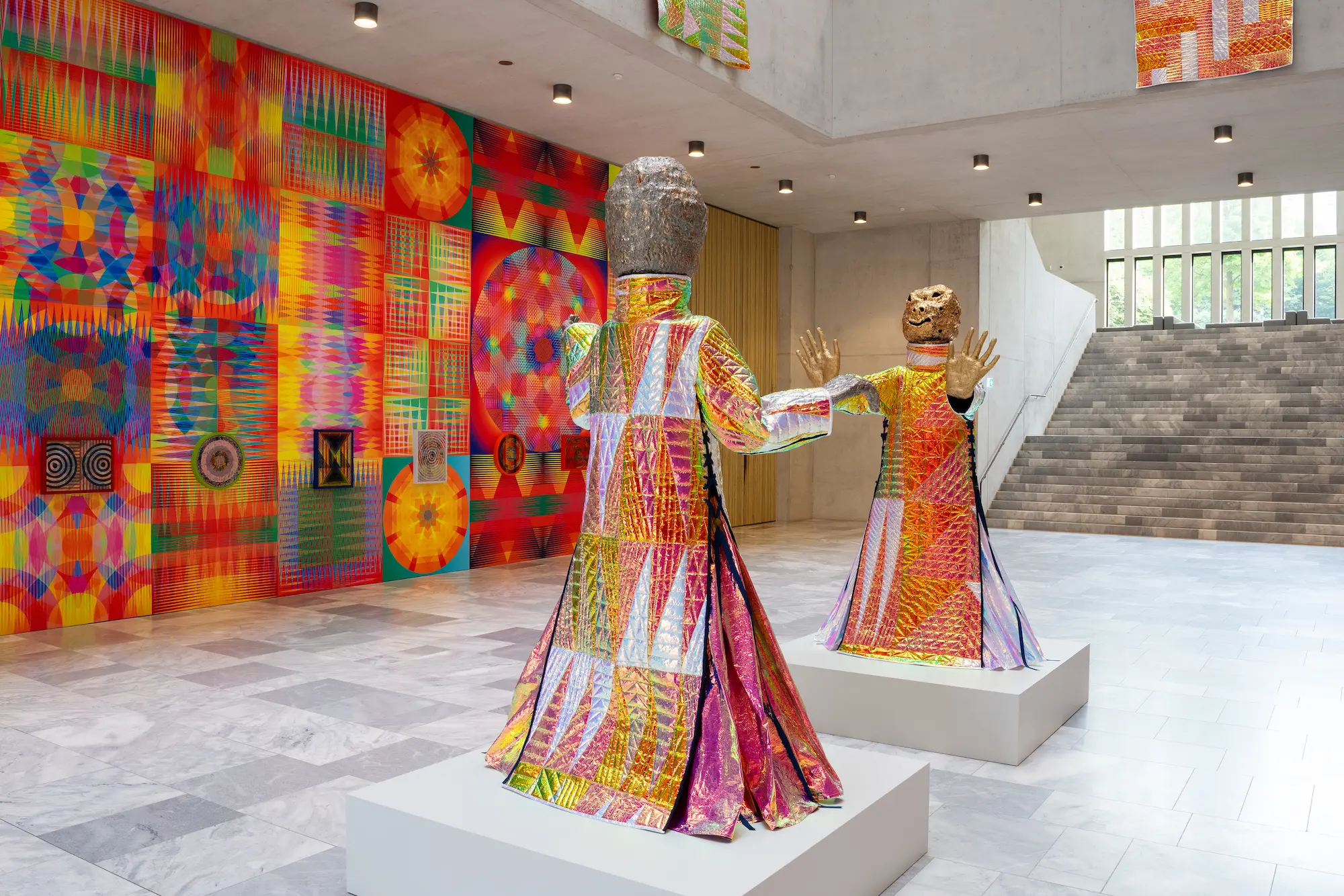
In the glass-sided Haefner Foyer, American multimedia artist Jeffrey Gibson has transformed the space into a festival of color and change. His monumental site-specific installation “boshullichi / inlᴜchi – we will continue to change” spills across the white marble hall, melding paintings, beadwork, textiles and found ceramics into a single immersive tapestry. The work’s palette, electric corals, vibrant turquoise, bold geometric patterns, enlivens the entry hall against Zurich’s winter light. Gibson’s title, drawn from the Choctaw language, literally means to break something apart… to dismantle and transform it and to make something different, to restore and rebuild it anew. In context, the foyer piece reads as a manifesto: history and craft are shattered and reassembled into a dynamic whole. Visitors find themselves dwarfed by shimmering dresses, towering bead panels inscribed with We Will Continue To Change, and the impasto of woven tapestries. The installation is open to performative activations, in practice, this means one might spy museum-goers spontaneously drumming on drums or interacting with the tactile components. For the winter visitor, Gibson’s piece is a burst of warmth and celebration in the chilly atrium: it literally refracts the outside light into the kaleidoscopic interior, reminding all that even in stone-cold season, culture, and change, flourish anew.


Upstairs, Wolfgang Laib offers a hushed counterpoint of stillness and contemplation. His exhibition Touching the Essential arranges some 50 of Laib’s elemental works in conversation with masterpieces from the museum’s collection. Known for invoking nature’s quiet forces, Laib has spent decades assembling ultra-minimal installations from pollen, beeswax, milk, rice and stone. In one gallery lies a perfect mound of bright yellow hazelnut pollen, glowing like a captured sun on the white pedestal, a piece that demands the viewer slow to a reverent halt. Elsewhere, a walk-through wax room and a Zen-like array of rice houses evoke shrine-like rituals. These sparing works feel almost monastic in winter’s still air, their soft textures and scent conjuring spring and ritual. In practice, one can see a pollen carpet lying quietly opposite a Monet or Rothko on the wall; it is as if the primordial and the transcendent are silently conversing. For the luxury traveler, Laib’s rooms provide a meditative oasis: here, the ambient hush contrasts the winter bustle outside, and each speck of pollen seems as precious as a gem. It is emblematic of Switzerland’s contemplative side, where even art is a practice in mindfulness and refinement.
Outside, in the Garden of Art’s soft snow, Monster Chetwynd has erected a playful colossal. Her project “Zardoz” is the museum’s first commissioned outdoor piece: an enormous sculptural head that doubles as a climbing folly. Carved and contorted like an ancient garden gargoyle, this head blends wit, history, and anthropology. Inspired by Renaissance grotto follies and even 1970s sci-fi camp, Zardoz invites visitors of all ages to step inside and explore its gaping mouth and internal rope ladders. The effect in winter is singular: amid bare trees and white lawns, the outsized head feels like a surreal totem of pop-surrealism. Chetwynd’s blending of art history, feminist wit and sheer fun recasts monumentality as playful, participatory experience. Children, bundled in snowsuits, clamber in and out, turning the sculpture into a spontaneous playground; adults pose through its eyes and mouths, cameras clicking for the ‘gram. In a season when the city sleeps under snow, Zardoz animates the garden, making art in public space a lively, joyful encounter. It is, in effect, the Garden of Art’s beating heart: a statement that even in the quiet of Zurich winter, creativity remains exuberantly alive.


At Kunsthaus Zürich in winter, every element, architecture, exhibition, ambience, is calibrated for refinement and enrichment. From Chipperfield’s limestone halls to Clark’s sensorial games, Gibson’s celebratory patterns to Laib’s zen-like stillness, each visit feels like a curated escape. In a city where snowy mornings bring crisp air and quiet reflection, the Kunsthaus shines as a cultural hearth. For the discerning traveler, it is a luxurious complement to skiing and spa retreats: here one warms body and mind alike.
© All imagery courtesy of Kunsthaus Zurich