Zonamaco 2026 and the Architecture of Influence in Latin Americas Art Market

Courtesy of Hauser & Wirth
Courtesy of Astra Marina Cabras
Courtesy of LA Art Show
Courtesy of Lukas Gansterer
Courtesy of Henge
Courtesy of Andreas Simopoulos
Courtesy of Dave Benett
Courtesy of Japan Mobility Show
Courtesy of ART Cologne
Courtesy of whenobjectswork / Kate Hume
Courtesy of Ivan Erofeev
Courtesy of Stéphane ABOUDARAM - WE ARE CONTENT(S)
Courtesy of Sacha Moreau / Global Gift Gala Monaco
Courtesy of Fadi Al Shami
Courtesy of Sofia Hartmann
Courtesy of Historyhd
Courtesy of Mick De Paola
Courtesy of the artist (c) VG Bild-Kunst, Bonn 2025. Photography by Jens Ziehe.
Courtesy of Yasamine June
Courtesy of Rawisara Prachaksubhanit
Courtesy of Mariia Dred for Berlin Fashion Week
Courtesy of Michael Fousert
Courtesy of Raden Prasetya
Courtesy of Antonia Tewes
Courtesy of Antonia Tewes
Courtesy of Carlo Bazzo
Courtesy of Artem Zakharov
Courtesy of James Cochrane / Copenhagen Fashion Week SS26
Courtesy of Fashion Week Studio
Courtesy of Burak Goraler / AFW
Courtesy of Antonia Tewes
Courtesy of SF / Luigi Caputo
Courtesy of Bruno Cordioli / CC BY 2.0 via Wikimedia Commons
Courtesy of Dubai Fashion Week / Ruzaini Official
Courtesy of Frieze Seoul 2025 / Wecap Studio
Courtesy of LecartPhotos
Courtesy of Jacopo Salvi / La Biennale di Venezia / ASAC Photo
Courtesy of Campione d’Italia’s Classic Circuit
Courtesy of Maxi Yacht Rolex Cup
Courtesy of Jochem Raat
Courtesy of Corey Watson
Courtesy of Pitti Immagine / Fragranze
Courtesy of Le Sable
Courtesy of Once Milano
Courtesy of Monaco Yacht Show
Photo by Darren Carroll/PGA of America
Courtesy of Guy Bell / British Art Fair
Photo by Sean Zanni / Patrick McMullan via Getty Images
Courtesy of Messe München GmbH / Thomas Plettenberg
Courtesy of ph G Martin-Raget/SNST
Courtesy of David Pupăză
Courtesy of Derek Rose
Courtesy of Jim Winslet
Courtesy of Millie Turner/BFI
Photo by Hugo Glendinning. Courtesy of Frieze
Courtesy of Rolex / Kurt Arrigo
Courtesy of Laura Dupuy
Courtesy of Palm Beach Show Group
Courtesy of Getty Images for Perelman Perfor
Courtesy of BFA 2025
Images credited Jason Alden courtesy of LAPADA
Courtesy of Informa Markets
Courtesy of The Qatar Boat Show
Courtesy of Getty Images for Baby2Baby
Courtesy of Jeanne Canto
Courtesy of Darian DiCianno
Courtesy of David Long/Cancer Research UK
Courtesy of Saslong Classic Club
Courtesy of Dieter Nagl für die Wiener Philharmoniker
Courtesy of Derek Rose
Courtesy of Lukas Gansterer
Courtesy of Sam Frost
Courtesy of Zonamaco
A
T
I
S
I
O
O
T
M
I
L
L
L
C
S
S
T
T
A
T
H
F
T
E
F
O
A
T
F
I
T
T
T
T
I
I
T
I
O
P
S
A
S
U
O
A
E
G
B
I
A
I
L
I
T
M
O
G
U
I
L
S
N
I
D
U
T
A
F
I
W
F
O
A
A
M
L
I
V
I
I
S
A
J
T
he fair's layered format reveals how regional art markets sustain international visibility through controlled intersections of commerce and curation.
Zonamaco 2026 positioned itself as a measured convergence point, where galleries from 27 countries signaled their stakes in Latin America's collecting networks. This edition maintained a disciplined expansion, introducing segments that tested the boundaries between art forms while preserving the event's core transactional rhythm.
Founded in 2002 by Zélika García, Zonamaco operates within Mexico City's broader cultural calendar, functioning as a hub that links local production to global circuits. It exists to facilitate the movement of works across borders, reflecting the mechanics of an art economy where Latin American narratives gain leverage through alliances with established European and North American institutions. Unlike Miami's Art Basel, which emphasizes spectacle to draw transient capital, Zonamaco embeds itself in the city's ongoing institutional fabric, sustaining relevance by aligning with February's art week ecosystem, museums, independent spaces, and parallel exhibitions that extend the fair's reach without diluting its market focus. This role underscores a format designed for collectors who prioritize context over immediacy, positioning the event as a ritual of validation rather than discovery.

The fair's dramaturgy unfolded over five days, with a protocol that segmented access and paced engagement. Preview days restricted entry to vetted professionals, creating an initial filter that shaped subsequent public interactions. Booths arranged in thematic sections, main, sur, moderno, diseño, and the new forma, directed movement, ensuring that contemporary works encountered historical counterparts in a structured dialogue.

Timing reinforced this: conversations programmed in the afternoons bridged morning viewings and evening gatherings, maintaining momentum without overwhelming the space. Such controls reveal how the event orchestrates meaning, turning navigation into a deliberate exercise where proximity to certain galleries signals one's position in the hierarchy of influence.
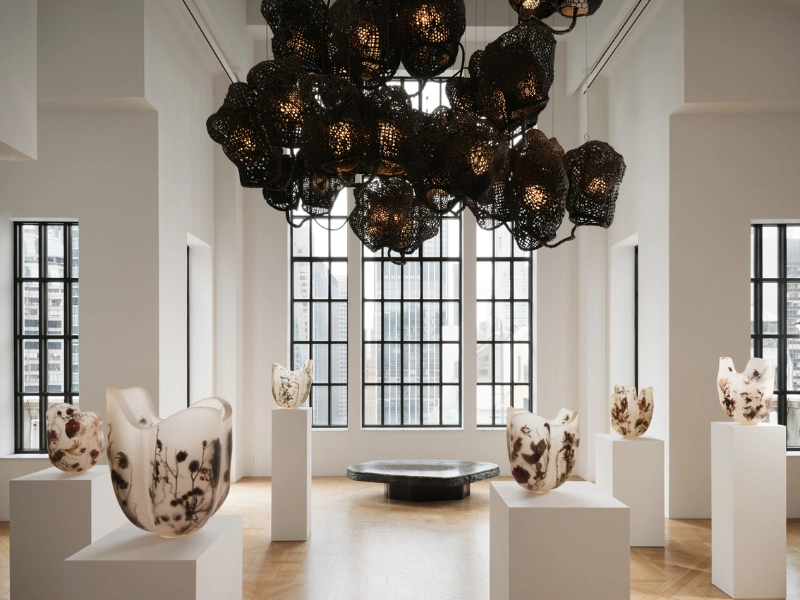
One curated moment centered on the launch of Zonamaco Forma, dedicated to art-design hybrids. Galleries like Carpenters Workshop and ADN presented pieces that blurred functional objects with sculptural intent, executed through precise installations that invited tactile inspection under controlled lighting. This addition exposed the fair's logic of adaptation, where expanding categories accommodates shifting collector interests, sustaining the format by absorbing adjacent markets without disrupting the primary art trade.
Another highlight emerged in the awards presentations, held mid-fair. The Tequila 1800 Collection Award recognized artists like Cirse Irasema and Naufus Ramírez-Figueroa, with acquisitions that integrated works into corporate collections. The execution maintained restraint, focusing on brief announcements rather than ceremonies, which highlighted the event's emphasis on circulation over celebration, revealing how such mechanisms propel emerging practices into institutional orbits, reinforcing the fair's role in calibrating career trajectories within a competitive ecosystem.
A third instance involved the conversation program, sponsored by Fundación Jumex, where curators like Manuela Moscoso addressed Global South narratives. Panels proceeded in a moderated format, with timed interventions that prioritized exchange over monologue. This structure illuminated the culture of reflection embedded in the fair, where discourse serves as a framework for market decisions, demonstrating how intellectual positioning maintains the event's authority amid broader industry pressures toward commercialization.
This edition's sponsor integrations warrant scrutiny, as they illustrate the tensions inherent in blending corporate agendas with curatorial independence. Brands like Mercedes-Benz and AXA embedded booths and perks, cashback incentives, branded lounges, that subtly directed attendee paths, raising questions about how such alliances influence visibility. Compared to earlier iterations, where sponsorships remained peripheral, 2026's approach integrated them more deeply, suggesting a calculated shift toward hybrid funding models. Yet this adds understanding to the fair's sustainability: in a region where public arts support fluctuates, these partnerships provide stability, even as they risk aligning artistic value with brand metrics.
Zonamaco 2026 concluded by signaling continuity, with dates set for 2027, framing its relevance as a persistent node in the art world's seasonal migrations.

Exclusivity doesn’t live in noise, it lives in the flow.